
Cultural Activism & Alternative Politics Reading Group: “Anti-Gender Politics in the Populist Moment” (Graff & Korolczuk, 2022)
Over its last few meetings, the Cultural Activism & Alternative Politics research cluster has been grappling with the question of anti-gender politics. That conversation was initially sparked by Judith Butler’s latest book, Who’s Afraid of Gender (2024), where Butler describes them as something which specifically resists rational discourse. Gender is posited as a “threat to all life” (p. 5), a marker of that “precarious life” that can only exist as danger to the real lives of real people (Butler: 2009). Assuming that diagnosis is fully correct, it poses a considerable problem in fields that engage with gender as a concept: what strategies can be deployed by educators, teachers and researchers to combat the anti-gender movement?
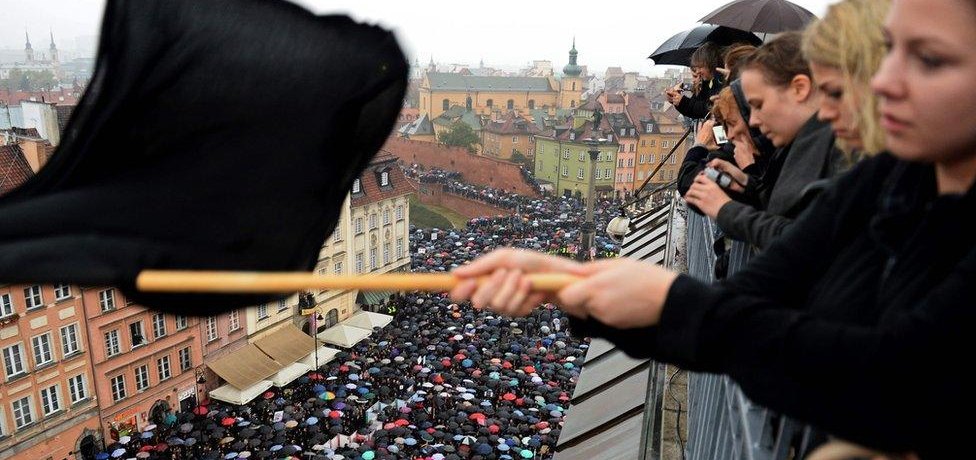
Those questions led us to read through Agnieska Graff and Elżbieta Korolczuk’s book, Anti-Gender Politics in the Populist Moment (2022), in particular its last chapter, “Toward a Popular Feminism”, containing as it does a case study resistance against the Polish anti-gender movement, the Black Protests of 2016, fighting against a proposed total abortion barn fuelled by the Catholic Church.
In Graff and Korolczuk’s analysis, gender, more than a theoretical concept, is a necessary component of current antidemocratic political movements. They describe anti-genderism “as a right-wing critique of neoliberalism” (p. 140) allowing for an uneasy alliance between new far-right formations and traditional conservatism. “Gender is no distraction from real politics; it resides at the heart of politics today, both as a set of specific policy issues and as the nexus of a symbolic struggle, a space where differences are negotiated and defined” (p. 164).
They argue that against the anti-gender movement and at the core of Black Protests is a new kind of populist feminism, one that is much more of a countermovement to traditional feminism than anti-gender politics ever were. That populist feminism labels women and the queer community as “the people” and anti-gender actors as “the elite” (p. 141) in a “gendered version of the ‘left populism’ theorised by Chantal Mouffe” (p. 143, cf. Mouffe: 2018). A “connective (as opposed to collective” (p. 153) action, it spreads through memes and hashtags in a very subjective and highly personalizable way, where a strike becomes not just a single action but a kind of all-encompassing and customisable “symbolic packet which cover[s] a wide range of activities” (ibid.), which allows much stronger participation from rural populations and underprivileged women that would be at risk if they only had the single path of engagement.
While they praise this new kind of feminist movement, Graff and Korolczuk do note that its ‘progressive’ nature is under question. It is not necessarily anti-capitalist or openly anti-neoliberal, and is prompt to use colonial-era discourses to defend the rights of a white female majority: they note in particular the use in the Black Protest rhetoric of allusions to South American countries like El Salvador, where abortion is illegal, as backwater counterpoints to the supposedly progressive and Western Poland, which really ought to know better (p. 150). Similarly, that opposition to a traditional feminism recasts older communities of feminist intellectuals and academics as the elite. As they report, “some activists angrily rejected books and articles about the protests published by scholars. Academic studies were viewed as illegitimate appropriations and exploitation of ordinary women’s lived experience and work” (p. 161).
They characterise those protests, along with Jenny Gunnarsson Payne (2020) as a driven by fantasy, appealing not to a notion of political choice, but to an affect of “dignity”, mobilised against “suffering or cruelty” (Graff & Korolczuk: 2022, p. 159); a strategy of provocation and moral shock; an “embodied and affective feminist knowledge emerg[ing] as an alternative to both the ultraconservative language of anti-gender actors and the alienating discourse of gender experts (p. 161).
Is it possible, though, to square teaching and education with this idea of “fantasy”? Is embracing a pure politics of affect really compatible with principles of investigation and research? While the structures of traditional feminist theory may be segregated behind class and culture barrier, is that inequality not the result of specific material conditions – ones that could be altered by the newfangled movement?
These unquestioned sweeping statements about the nature of feminist and class politics were unanimously picked up in our discussion session. Graff and Korolczuk assume that the rise of populist feminism is correlated with the co-optation of feminist ideology by neoliberalism, which made it seem untrustworthy and precipitated this new affect-based movement. They do not define which specific structures of feminism were coopted exactly (or if these concepts were indeed left-wing to begin with: there is quite a large gulf between, say, Teresa de Lauretis and the rise of the internet #girlboss), nor do they say why the Left alone should be held responsible for its cooperation with neoliberalism. The “expertise” of the former feminist class is uncritically read as “privilege”.
Similarly, we were not entirely convinced by the idea of populist feminism as a new and positive force despite its rhetorical faux pas. In claiming to be “ordinary” women fighting for a kind of transcendental decency, isn’t the movement fundamentally denying the very nature of its political action, instead retreating into a “Silent Majority”? And is that concept of “connective” action not simply the evolution of activism in the age of social media – as observed during the Arab Spring or the 2020 Black Lives Matter Protests?
Most problematic of all, however, might be the importance placed affect as driver of political action. In this, much like Mouffe, they find themselves in the continuity of Frédéric Lordon’s (2016) writings about the role of affects in politics: but in his account, it is right-wing politics that specifically mobilise “negative” – which is why the Left needs an emotional counter-arsenal to mobilise against these strategies. By eluding this political project and simply proclaiming the newfangled supremacy of emotion, Korolczuk and Graff find themselves in an awkward position: nothing can guarantee that a “populist feminist” powered by sheer apolitical affect will stay a force for good for very long. After all, as a cluster member pointed out, is not contemporary trans-exclusionary feminism such a form of affect-based, populist feminism, heralding as its first unmoved mover feelings of fear and disgust related to “improper” gender circulations? Do we have to renounce all rationality, facts and arguments to “win” the culture war?
If such strategies even allow for a durable victory. Tellingly, in the 2025 Polish Presidential elections, the far-right candidate prevailed, continuing the Law and Justice (PiS) party eight years old hold on the role (Picheta: 2025). Plus ça change …
_____________________________________________________________
Sources:
- Butler, J. (2009). Frames of War: When is Life Grievable? London: Verso.
- Butler, J. (2024). Who’s Afraid of Gender? London: Allen Lane.
- Graff, A. & Korolczuk, E. (2022). Anti-Gender Politics in the Populist Moment. New York: Routledge.
- Gunnarsson Payne, J. (2020) ‘Women as ‘the People’: Reflections on the Black Protests as a Counterforce Against Right-Wing and Authoritarian Populism’. in: Baltic Worlds (issue 13, vol. 1). pp 6–20.
- Lordon, F. (2016. Les affects de la politique. Paris: Seuil.
- Mouffe, C. (2018). For a Left Populism. London: Verso.
- Picheta, R. (2025). “Populist Karol Nawrocki wins Polish presidential election, setting stage for more clashes with PM Tusk”. CNN (online). https://edition.cnn.com/2025/06/01/europe/poland-presidential-election-result-trzaskowski-nawrocki-latam-intl?_hsenc=p2ANqtz-8PYo-LTlm5beUn-BTfOS3_Iu2n-t3TwS7whkwq9TdkY6j72tBwUWHxzKAvHESLvCtasdfv [accessed 08/10/2025].