

more than dusty grey boxes: feminist archiving to reveal women’s local histories
by Ambrose Loveridge and Annette Naudin
Seeing Rhonda celebrates the life and work of Birmingham photographer Rhonda Wilson through the creation of a new archive, housed at The Old Print Works. Rhonda’s ‘archive’ was not strictly speaking an archive until we began the process of organising and cataloguing the rolls of posters, photographs, magazines, and materials discovered in dusty boxes. Working in collaboration with art history student, Ambrose Loveridge, our approach came out of a desire to take ownership of the archiving process. Borrowing from feminist practices we engaged directly with the materials before deciding how to go about creating the Rhonda Wilson Community Archive. There were three key factors which influenced our method: firstly, we imagined how audiences might access and engage with the archive; secondly, we familiarised ourselves with the nature and content of the materials by exploring and simply being curious; and finally, we drew on contextual information including the stories of women who had known Rhonda to situate the collection of materials.
Ambrose tells the story of sifting through materials, creating a cataloguing system and discovering Rhonda.
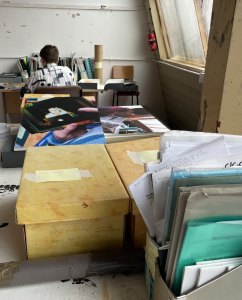 I initially became aware of the opportunity to work within the Rhonda Wilson Community Archive through the Culture Forward Internship programme at the University of Birmingham. As a first-year History of Art student with a particular interest in both contemporary photography and archival practice the entire project was immediately intriguing. Subsequently, I decide it would be valuable to partake in exploratory research of Rhonda’s life and work. Yet, to my surprise, the resources were extremely limited with most information being confined to Wikipedia and some small blog posts. However, the information that was available did not fail in reeling my interest further.
Rhonda’s archive is hosted and found in The Old Print Works in Balsall Heath, Moseley. The Old Print Works as a location embodies the work that Rhonda championed through her own community involvement. It is a space that revolves around communal creativity that makes art accessible for all. Additionally, Balsall Heath is close by to where Rhonda and fellow creative, Ming De Nasty, set up Poseur Studios. This studio facilitated much of the work produced as a part of Rhonda’s early career, such as the ‘Worth Paying For’ campaign. As a result, The Old Print Works feels like the perfect place to house The Rhonda Wilson Archive.
While working through the archive I have been introduced to the person that Rhonda really was, the immense and widespread impact she had on contemporary photographic practice, not just in Birmingham but internationally, and the stalwart activist she was throughout her life. It shocked me that I had no knowledge of her prior to my involvement with this project. Thus, my main goal in cataloguing became clear; I wanted to make Rhonda’s life work, not only in image producing but also her personal involvement with feminism, activism and funding, clear and accessible to all that were interested.
Preservation of Rhonda’s own ideology and activist roots was considered from the outset. It was important for both me and Annette that voices and views that usually become marginalised or forgotten in traditional archiving systems were bought to the forefront of Rhonda’s archive. Feminist and community archive approaches were considered in tandem to create a system that was sympathetic to the sensitivity and feminist roots of the archive material. The preliminary system I created failed to consider the provenance of the materials and therefore had to be reworked. I wanted to preserve Rhonda’s original organisational system while ensuring that all aspects of her work were sorted by easily accessible categories. As a result, we chose to use subject columns that would contain specific labelling for each box, this prevented the marginalisation of material as the entire cataloguing system is transparent. The cataloguing system deviates from conventional institutional approaches as Rhonda’s archive required both nuance and accessibility. The system we created was what we felt would fit Rhonda’s work best.
 A particular item that has stuck with me over the course of my time cataloguing is RW/003.1/010. This note from Sue thanks Rhonda for the ‘tremendous adventure’, that the Women with Attitude photography event, was. Many such notes can be found in the archive, and they serve as a testament and real-world example of the immense impact Rhonda had, not just in the photographic world but on an individual level for many female creatives. This item reminded me many times that the preservation of archives, like Rhonda’s, is not just preserving Rhonda’s legacy but the history and struggles that female creatives have faced and continue to face in accessing the creative industries, while often facing marginalisation and discrimination.
The work I have done at the Rhonda Wilson Community Archive has been both enlightening and rewarding. I have learnt so much about the photographic heritage of Birmingham and the ways that people like Rhonda, helping others so consistently, often fade into the background when there is no one to uplift their story. My main hope for the archive is that it will serve as a valuable resource for academics and the local community, as a way of connecting with their cultural heritage. I hope that academics can focus on Rhonda’s life’s work as well as the many other women like Rhonda whose stories have been too long neglected by institutions. Overall, I want Rhonda’s legacy to open conversations about the role of the archive in gatekeeping material and in turn marginalising individuals.