
Journalism Education Reimagined Conference
Journalism Education Reimagined Conference: Global Perspectives, Future Pathways
Overview
From Dialogues to Declaration to Action
 Journalism educations currently faces unprecedented challenges, from the UK’s £108 million cuts to higher education to similar pressures being faced worldwide. These are not only pressures that are being faced within the Global North, but also the Global South. Yet, in encountering these challenges, new dialogues and synergies are formed to respond to these pressures and find new paths forward. That is where Journalism Education Reimagined responded, to bring together global perspectives across the Global North and Global South to create transformative dialogues and collaboration.
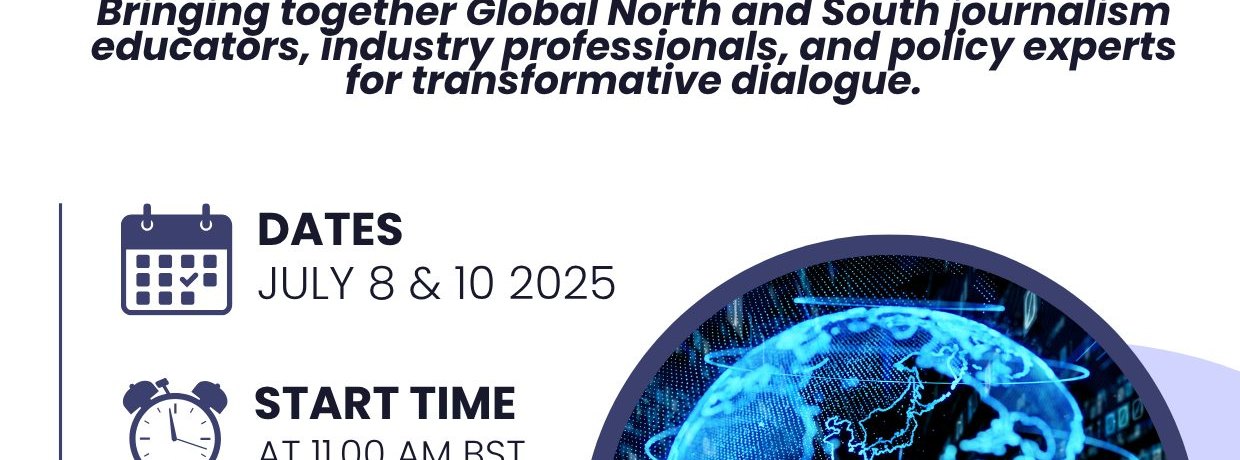
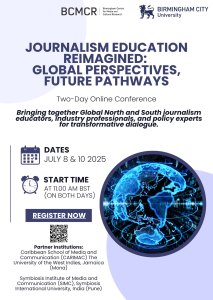
Journalism Education Reimagined: Global Perspectives, Future Pathways was a two-day virtual conference exchange that occurred on Tuesday 8th and Thursday 10th of July. By recognising these global challenges, the conference brought together Global North and South journalism educators, industry leaders, and policy specialists in dialogues to reimagine journalism education for democratic society. This exchange explored innovation of journalism education and the industry in all directions, further recognising that the Global South is not only catching up to Global North models, but pioneering approaches too.
The conference was a joint effort between the Birmingham Centre for Media and Cultural Research (BCMCR) (Birmingham City University, UK) as the lead institution, in partnership with the Caribbean School of Media and Communication (CARIMAC) (The University of the West Indies, Jamaica (Mona)), and Symbiosis Intitute of Media and Communication (SIMC) (Symbiosis International University, India (Pune)). Across the two days, the conference welcomed attendees all across the globe through panel presentations, knowledge exchanges, strategic working groups, and formation of a Global North and Global South journalism education research network. Further, the conference featured an “International Support Statement on Journalism Education,” a collective statement amplifying the global voice affirming journalism’s democratic importance and challenging narratives that journalism education is expendable.
What has been unique about this dialogue is its transformative Global North-South exchange that has explored innovation across all directions, its currency in learning of the cutting-edge practices within journalism education, and its action-orientated purpose in building resilient partnerships for sustainable North-South collaboration.
Using the links provided in the contents below, you can access and view the recordings of the presentations that were delivered as part of the conference. In demonstrating the collaboration across these Global North-South partnerships that were created during the conference, you can also find additional resources, materials and opportunities that have been shared by the attendees and community.
Table of Contents
Day 1: Global Innovation Showcase – Presentations
This section of the page features recordings of the presentations delivered on Day 1 of the conference. Below are links to the different session panels that were part of the conference programme. Click on one of them to direct you to the presentation recordings for that panel.
Conference Opening & Closing
Panel Presentations
Session 1: Digital Teaching Innovation
Session 2: Global Collaborative Networks
Session 3: Equitable Technology and Industry Alignment
Resources and Materials
This section features links to external sites for further information, resources and opportunities that were shared by attendees and presenters at the conference.
Conference Opening & Closing
- Welcome & Conference Vision by Dr Rachel-Ann Charles (Birmingham City University, UK), Conference Chair.
- Opening Remarks by Ms Sylvie Coudray, Director, Division for Freedom of Expression, Media Development, and Media and Information Literacy. Secretary, International Programme for the Development of Communication, UNESCO.
- Closing Remarks by Dr Patrick Prendergast Director Caribbean School of Media and Communication (CARIMAC) (The University of the West Indies, Jamaica (Mona)).
- “Keeping it Real – a critical reflection on how UK HE practical journalism courses keep pace with an evolving industry” by Hilary Scott, Senior Lecturer (University of Northampton, UK)
Session 1: Digital Teaching Innovation
- Dr Sushobhan Patankar, Symbiosis International University (India) – “Using Mobile Journalism for Multimedia Storytelling and Documentary Filmmaking”
- Dr Abhishek Roy, Symbiosis International University (India) – “The Augmented Journalist – Access & Inclusion of AI Technology in Marathi Regional News Media in India”
- Dr Noha Atef, University of Galway (Egypt/Ireland) – “Teaching Social Media to Gen Z: Cross-Cultural Experiences”
- Paul Bradshaw – Associate Professor, Birmingham City University (UK) – “AI Diary and CustomGPT: Lessons from AI Integration”
- Tshepo Tshabalala, JournalismAI, London School of Economics (UK) – Bridging the Gap of AI and Journalism Training
Session 2: Global Collaborative Networks
- Adala Khalil, University of West London (UK) – “Where theory ends and Journalism Begins: A student’s perspective on launching an independent platform”
- Dr Carolyne M. Lunga, City, University of London (UK) – “Cross-border Investigative Journalism Education: Possibilities and challenges”
- Hannah Ajala, BBC & We Are Black Journos (UK /Nigeria) Award-winning journalist – “How your ideas can have the magnitude to go global”
- Dr Lia Seixas, Universidade Federal da Bahia (Brazil) – “Academic Dialogue Between Regions”
- Dr Ruchi Kher Jaggi, Symbiosis International University (India) – “The Future Is Co-Taught: Lessons from India”
Session 3: Equitable Technology and Industry Alignment
- Adrian Ma – Associate Professor, Toronto Metropolitan University (Canada) – “Open Educational Resources and Accessibility”
- Rod Amner – Senior Lecturer, Rhodes University (South Africa) – “Community-Centered Journalism in University-Owned Newsrooms”
- Co-presenters: Phila-Nathi Mapisa & Aphiwe Ngowapi (MA Students) Rhodes University (South Africa)
- Farah Jallad, Arab Reporters for Investigative Journalism (ARIJ) Senior Editor (Arab Context) – “Industry-Academia Collaboration in Investigative Journalism”
- Nikolia Apostolou, Global Investigative Journalism Network (GIJN) Resource Center Director (Global context) – Democratising Journalism Education
Resources and Materials
- 📚 Learn more about UNESCO’s work on journalism education, including handbooks on Reporting on AI and Teaching Journalism Online:
🔗 https://www.unesco.org/en/international-programme-development-communication/journalism-education?hub=67168
- 📘 The UNESCO Series on Journalism Education – 20+ open-access handbooks, freely accessible and designed for localisation:
🔗 https://www.unesco.org/en/international-programme-development-communication/journalism-education/resource-hub?hub=67168
- ✅ Criteria for Excellence in Journalism Education
Available in EN, FR, AR, ES, PT – Swahili coming soon:
🔗 https://www.unesco.org/en/criteria-excellence-journalism-education-africa?hub=67168
- 🌍 Promoting Excellence in Journalism Education in Africa
A multi-phase initiative involving 80 journalism schools in 37 countries:
🔗 https://www.unesco.org/en/international-programme-development-communication/journalism-education/journalism-education-africa?hub=67168 - For any questions, feel free to contact the UNESCO IPDC Secretariat:
📧 ipdc.secretariat@unesco.org
- 📢 IPDC’s Annual Call for Proposals for grassroots media organizations – Learn how to apply:
🔗 https://www.unesco.org/en/international-programme-development-communication/projects?hub=668